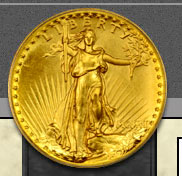
The first United States gold coins were half eagles made in 1795. These appeared two years after the first American copper coins and one year after the first silver coins. These new coins had a face value of five dollars. The Coinage Act of April 2, 1792 authorized the half eagle. The production of the half eagle officially began on July 31, 1795; 744 half eagles were made on that first day. It was to weigh 135 grains and be made of .9167 fine gold. This weight and fineness did not change until the Act of January 18, 1837 when the weight became 129 grains and the fineness became .900.
Capped Bust to Right (1795-1807); Capped Bust to Left (1807-1812); Capped Head to Left (1813-1834); Classic Head, No Motto (1834-1838); Liberty Head (1839-1908); Indian Head (1908-1929).
BD-9, R-5+. Crisply struck. Lovely (unlike many dogmeat comps like the NGC MS61 that recently sold in auction). Evergreen 1st year of issue. Bid=90,000. PCGS:130,000. More
>>>
Variety: BD-7, R-6+, 15 Stars Obverse, 16 Stars Reverse, nearly impossible to obtain Large Eagle Variety One of the great early gold rarities and a major one. Among the top finest known examples to exist. Pop PCGS 1/3 (finest is Pogue's 62+); NGC 0/0 (the pop report might still say 1/0 but that will change soon ) PCGS Retail Guide = $340,000 So rare that the Smithsonian doesn't have one. Rich honey colors with deeper orange undertones. Very attractive.
From the Pogue auction writeup:
The overdate seen on this variety is one of the boldest in the entire realm of American coinage, easily as plain as the 1942/1-D dime, 1918/7-D nickel, 1918/7-S quarter, and other well-known but comparatively common overdates. The 5 underdigit has not been effaced at all, though the flag of the 7 lines up precisely enough with the flag of the 5 to mask it.
Three die varieties of 1797 half eagle are known with the Heraldic Eagle reverse. This is the only one that is not unique. David Akers posited that 12 to 15 specimens were known, while Dannreuther suggested 16 to 20 in all grades. Akers described this coin as "either the first or second finest known example of this extremely rare issue. (Its status as first or second best depends on the quality of the Dunham [B. Max Mehl, 1941] example, long thought finest ...)." The Dunham coin is a cypher; its description of "Uncirculated, with brilliant mint luster; only the faintest touch of cabinet friction" could easily describe a coin that would today qualify as About Uncirculated, and its photograph is useless. This example, the finer of just two Mint State coins ever graded by PCGS, stands alone as finest known.
BD-2, R-6+. Rarely offered, particularly problem-free. Sharp and lustrous. Rare. Less than two dozen known. Old holder. NGC$75,000. PCGS$80,000. NGC pop 1/6More
>>>
18143 $5 PCGS MS62-BD-1, R-4+. Crisp & lustrous. I believe this example will eventually find it's way into an MS-63 holder as it displays all the attributes and quality of an MS-63 coin. Early half eagle rarity in very choice uncirculated condition among the nicest you will ever put a loupe to!More
>>>
BD-1, R-4+. Crisp & lustrous., PCGS $45,000.00, Wonderful Capped Head half eagle in choice uncirculated and quite nice for the grade, premium quality. Rarely seen this nice.
Ex-SS New York. Finest of five on the ship! Dahlonega shipwreck treasure. Pop exclusive of shipwreck: NGC 5/2, PCGS 4/4. PCGS (non-ship):22,500. More
>>>
Conditionally rare. Only 2 graded finer. Within months of this coin being struck the country would explode in Civil War and quite a lot of reliance now on the San Francisco Mint. TOTAL pops on this great wild western half eagle are 4/2 at NGC and 7/0 at PCGS!. Awesome example for a S-mint type set of gold or as a stand alone investment gold coin.More
>>>
1861 Civil War Gold Set - 1861 Gold Dollar NGC AU55, 1861 Quarter Eagle NGC AU55, 1861 Half Eagle PCGS XF45, 1861 Eagle NGC AU55, 1861 Double Eagle NGC XF45 CAC...More
>>>
Very scarce 1862 $5 Half Eagle in choice about uncirculated condition. Tough Civil War date and denomination with excellent surfaces and strike. More
>>>
Rare PROOF. Mintage 25. Pops inflated by resubmissions. Light handling reduced this uber rare proof to proof 58, just a whisper away from uncirculated proof gold.More
>>>
Very difficult to locate this nice is this 1874-CC Half Eagle in very choice about uncirculated condition that looks nicer than what the technical grade would indicate. Very sharp graders look at this coin and immedietely grade it AU-55! Very scarce.More
>>>
Rare Carson City half eagle of 1874-CC in very choice about uncirculated, a whisper away from unc. Conditionally rare. Only 5 finer. Gorgeous wild west gold. PCGS shows $45,000More
>>>
Even rarer than the mintage of 36 suggests, Total pops both services as follows 1/3, 0/7. I have a proof gold dollar, a lower grade ( prf 60 ) eagle and a proof double eagle so yes Matilda, we can assemble a gold proof set in inventory. This 1880 $5 and the previously mentioned 1889 2.5 would also be a good starting point as both of them have really low mintages and a survival rate that's even lower.More
>>>
Well I saved my pennies and I saved my dimes...giddy up giddyup 1909, before I knew there would be a time, giddy up giddy up 1909, that I would own a Gem Unc Indian Gold 1909.More
>>>
US Gold is heavily collected and invested in. In the case of this 1911 Indian Half Eagle, Only 4 graded numerically finer. Exceptional eye appeal.More
>>>
The first United States gold coins were half eagles made in 1795. These appeared two years after the first American copper coins and one year after the first silver coins. These new coins had a face value of five dollars. The Coinage Act of April 2, 1792 authorized the half eagle. The production of the half eagle officially began on July 31, 1795; 744 half eagles were made on that first day. It was to weigh 135 grains and be made of .9167 fine gold. This weight and fineness did not change until the Act of January 18, 1837 when the weight became 129 grains and the fineness became .900.
Capped Bust to Right (1795-1807); Capped Bust to Left (1807-1812); Capped Head to Left (1813-1834); Classic Head, No Motto (1834-1838); Liberty Head (1839-1908); Indian Head (1908-1929).